Harmful Algal Blooms Monitoring to Protect Mid-Atlantic Waters and Communities
Harmful algal blooms (HABs) occur when certain microscopic algae grow rapidly, producing toxins or depleting oxygen in the water. These events can threaten marine life, disrupt fisheries and aquaculture, and impact public health and recreation. MARACOOS partners with researchers and federal agencies to improve how the Mid-Atlantic region monitors, predicts, and responds to HAB events—turning scientific data into tools that protect coastal communities and economies.

National Harmful Algal Bloom Observing Network (NHABON)
MARACOOS is part of the National Harmful Algal Bloom Observing Network (NHABON)—a joint effort between the U.S. Integrated Ocean Observing System (U.S. IOOS) and the National Centers for Coastal Ocean Science (NCCOS) that connects federal, state, and local entities. This collaboration integrates diverse capabilities to enhance monitoring, event response, and forecasting of harmful algal blooms (HABs).

Modeling and Forecasting
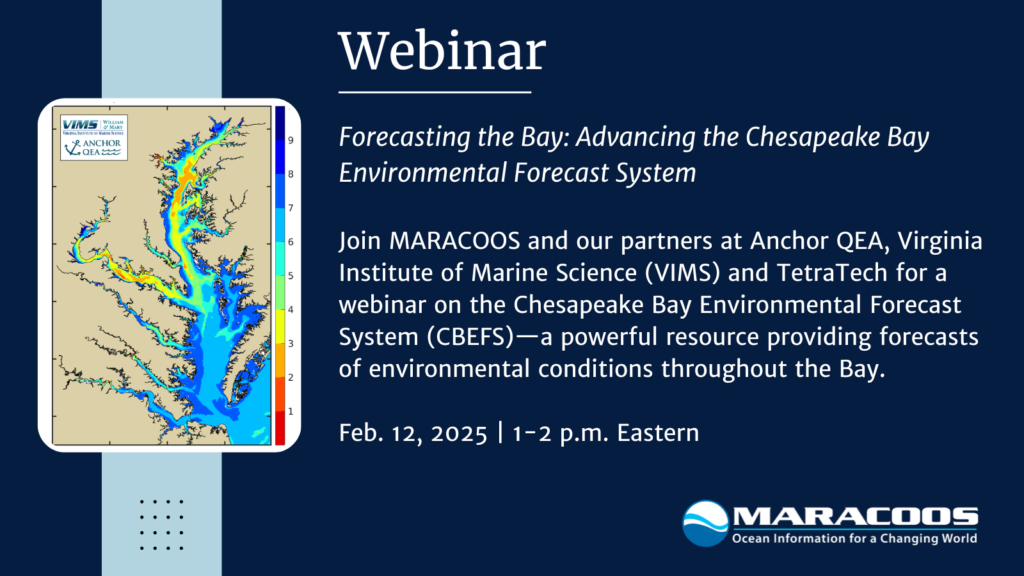
MARACOOS supports the Virginia Institute of Marine Science’s (VIMS) Chesapeake Bay Environmental Forecast System (CBEFS) to enhance HAB forecasts. This work uses models to estimate bloom likelihood [NEED REST OF TEXT HERE]

Developing a Chesapeake Bay HAB Forecast System
With funding from MARACOOS, researchers at VIMS and Old Dominion University are building a HAB monitoring and forecast system specifically for the lower Chesapeake Bay, focused on two [NEED REST OF THE TEXT HERE]
Supporting Safer, Healthier Waters
Through these coordinated efforts, MARACOOS and its partners are advancing the region’s capacity to monitor and forecast harmful algal blooms in near real time. By transforming complex ocean data into practical, accessible tools, MARACOOS helps safeguard marine ecosystems, coastal industries, and the well-being of communities across the Mid-Atlantic.
NHABON Current Projects
Partners/CoPIs: St Mary’s College of MD (Emily Brownlee) and UMCES (Greg Silsbe)
Partners at St. Mary’s College of Maryland and UMCES are developing a unified, community-driven phytoplankton image library within the MARACOOS database to support regional HAB monitoring. The project brings image collections from IFCB, PlanktoScope, and FlowCam instruments together into a standardized library for the Mid-Atlantic region.
Images will be organized by instrument type and species with relevant metadata for easy access and use. Through a regional user workshop and input from existing projects, the team will establish shared data management practices and create clear guidance for contributing, uploading, and downloading image sets. They will also maintain a GitHub repository featuring Python-based image classification tools trained on the new MARACOOS libraries, expanding the resource’s value and encouraging collaborative data sharing across the Mid-Atlantic.
North-East Shelf LTER research cruises, spanning from Cape Hatteras to the Gulf of Maine, collect long-term phytoplankton and water column data to track HAB species and year-to-year variability. Dr. Mulholland’s lab will use EcoTaxa to analyze IFCB imaging data, focusing on current and emerging HABs in under-monitored areas of the Mid-Atlantic. Data from the Pioneer Array near Cape Hatteras and semi-annual servicing cruises d will be included, with the annotated IFCB database hosted on MARACOOS OceansMap as the regional hub for phytoplankton imagery. This work will improve the understanding of HAB presence in unmonitored waters and identify species potentially emerging due to a changing climate.
The Harmful Algal Bloom and Hypoxia Research and Control Amendments Act (HABHRCA) established an interagency working group of 13 federal agencies to improve detection, monitoring, assessment, and forecasting of HABs. NOAA leads for marine and Great Lakes waters, while EPA co-chairs and focuses on freshwater, with both agencies using satellites and monitoring programs to produce HAB forecasts and respond to HAB events. Currently, their data systems are separate, making it challenging to create a unified national view of HABs. Integrating these datasets could improve understanding of factors driving blooms—such as wind, currents, temperature, nutrients, and salinity—and support research on HABs as a climate change co-stressor affecting aquatic ecosystems. MARACOOS aims to advance interoperability by engaging NOAA and EPA stakeholders, reviewing their HABs data holdings, and developing a prototype framework to connect key datasets for more comprehensive analysis and forecasting.
Related News
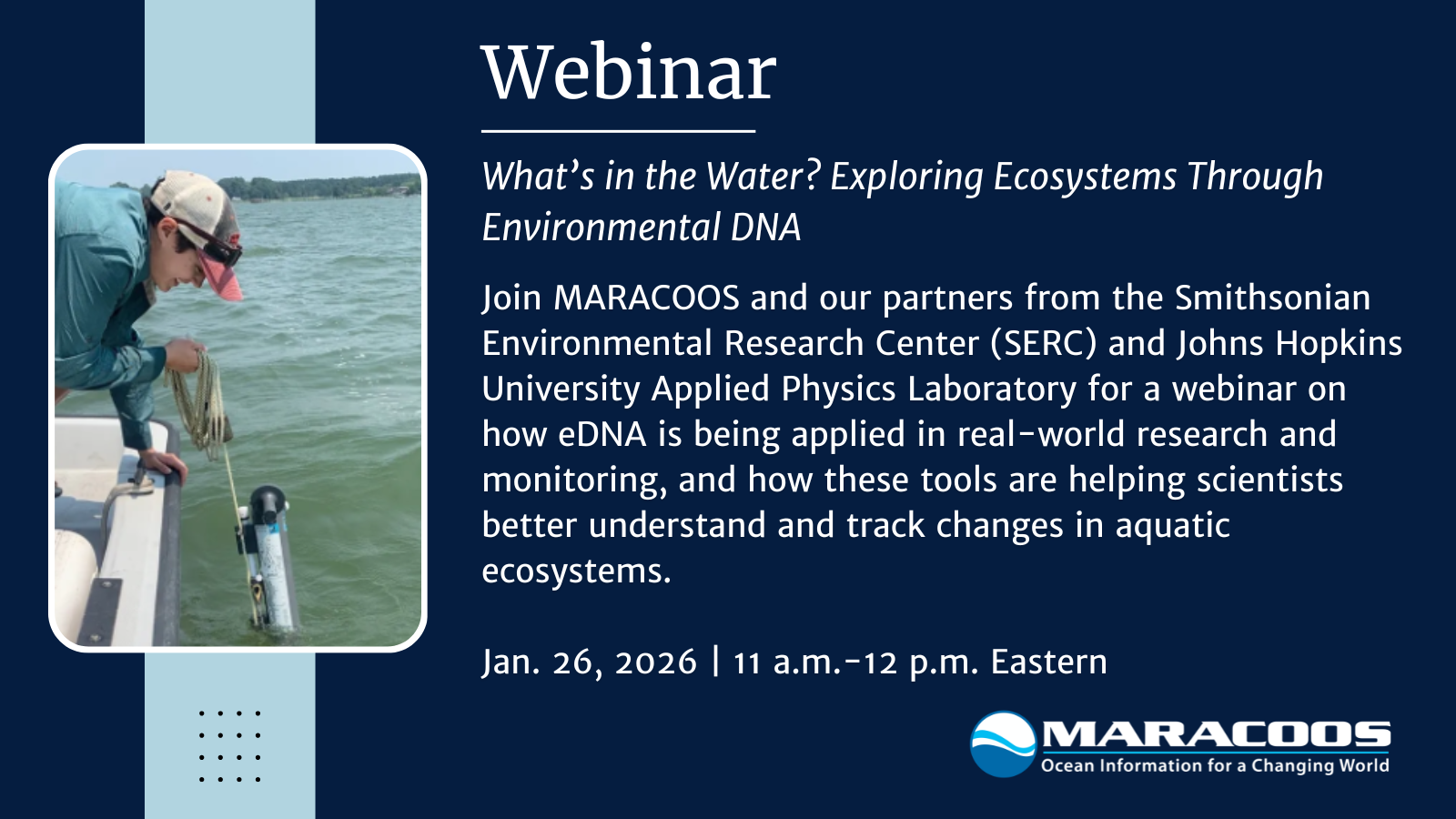
Webinar: What’s in the Water? Exploring Ecosystems Through Environmental DNA
Explore Other Projects
- ECCOFS
- Improving Coastal Safety Through Coastal Hazard Monitoring and Risk Management
- Mid-Atlantic Coastal Acidification Network (MACAN)
- Mid-Atlantic MBON
- Ocean Integrating Ocean and Weather Data Through Shared Infrastructure
- OTT – Animal-borne Sensors
- Tracking Marine Species and Biodiversity Hotspots to Support Ocean Management
- Water Levels, Waves & Webcams (WWW Network)