The hearing included bill H.R. 2294, which supports regional observing systems like MARACOOS and would reauthorize the Integrated Coastal and Ocean Observation System Act.
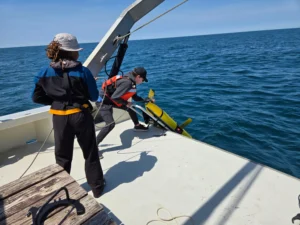
An underwater glider being deployed by researchers. Gliders are just one of the many pieces of technology that MARACOOS uses to collect ocean data. Photo credit: Donglai Gong, VIMS.
On Tuesday, May 20, a long-time member of the nation’s ocean and coastal observing community testified in support of the reauthorization of the Integrated Coastal and Ocean Observation System Act. This legislation, enacted in 2009 and reauthorized in 2020 under the first Trump administration, created the Integrated Ocean Observing System (IOOS) and developed the nationwide network dedicated to providing critical infrastructure that supports national security, economic resilience, efficient maritime commerce and public health and safety.
IOOS provides the backbone that allows 11 regions across the U.S. — including MARACOOS to gather the data needed to support the nation’s blue economy. MARACOOS is the association focused on gathering and disseminating data in the Mid-Atlantic and is responsible for developing a network of marine scientists, resource managers, governmental and non-governmental organizations and other stakeholder groups that collect and combine their data to provide timely and reliable information about our oceans — similar to the information gathered by the National Weather Service to develop weather forecasts.
Dr. Stephan Howden, Professor at the University of Southern Mississippi and Director of the Hydrographic Science Research Center, has been a leader in the development of the nation’s observing system and is current a Board Member for GCOOS, the regional observing association based at Texas A&M University that is focused on the Gulf of America. He testified at Congress before the Water, Wildlife and Fisheries Subcommittee of the House Committee on Natural Resources. The bipartisan H.R. 2294 was introduced on March 24 by Rep. Mike Ezell (R-MS), with co-sponsors Suzanne Bonamici (D-OR), Randy Weber (R-TX), Debbie Dingell (D-MI), Aumua Amata Coleman Radewagen (R-AS), and Danny K. Davis (D-IL). The bill has gained 15 additional bipartisan sponsors since its introduction. The legislation would reauthorize IOOS for the next five fiscal years, maintaining its authorized funding level at $56 million annually.
“IOOS is one of the most cost-effective, impactful federal programs supporting our ocean, coasts, and Great Lakes,” Dr. Howden testified. “It’s a cross-sector, bipartisan success story. And reauthorizing it is not just smart policy—it’s essential for public safety, national defense, economic growth, and resilience… In recent years, we’ve deployed ocean gliders—low-power, autonomous vessels that measure heat content in the upper ocean. Why? Because storm intensity is still the hardest part of hurricane forecasting, and the temperature of the ocean is a major factor driving its intensity. It has been shown that these gliders are cost-effective and capable of helping NOAA’s National Hurricane Center improve intensity forecasts by up to 50%. That means more accurate warnings, better evacuations, and billions in potential savings. IOOS is not just about science and data. It’s about safety, sovereignty, and smart governance. Reauthorizing this critical law is a win for our nation.”
Watch Dr. Howden’s testimony on YouTube and read his full remarks online on the GCOOS website.
The bill ensures continued support for critical ocean monitoring efforts that benefit coastal communities, fisheries, and maritime industries. “IOOS is essential to keeping coastal economies strong and resilient, especially in Mississippi,” Representative Ezell said at the bill’s introduction. “This reauthorization ensures we maintain vital ocean monitoring resources while modernizing the program to maximize its impact. I’m proud to introduce this legislation to support jobs, commerce, and our nation’s leadership in ocean science.”
The data that MARACOOS hosts and disseminates includes:
- Near real-time ocean data to enhance vessel safety, port efficiency, and navigation in the Mid-Atlantic, supporting USCG search and rescue, NOAA PORTS®, and commercial forecasts.
- Near real-time data on bottom temperature, salinity, and currents, partnering with NOAA Fisheries to deliver forecasts and habitat insights, supporting sustainable Mid-Atlantic fisheries and aquaculture.
- Near real-time data using radar, gliders, and sensors to help emergency managers and forecasters improve storm tracking, flood prediction, and coastal hazard assessments.
After the hearing, MARACOOS Executive Director, Dr. Gerhard Kuska, said that “IOOS has been and remains a key priority for our nation’s national security, safety, economy, and jobs. As retired United States Navy Admiral James Watkins, Chairman of the U.S. Commission on Ocean Policy stated in his 2004 testimony to the Senate on the Commission’s report: ‘The Integrated Ocean Observing System is the only program that we’re really pushing very hard by this commission. The rest is policy, but this one we feel is so connected with policy and so connected with implementation that it must go forward, must be a national commitment. We must move out on it.’” Dr. Kuska added, “President Trump recognized this critical need when he reauthorized IOOS in 2020, and now is the time to continue to strengthen and expand IOOS’ ability to implement the President’s priorities for our Nation.”
As one of eleven certified U.S. IOOS regional associations, MARACOOS is dedicated to delivering high-quality ocean and coastal data to stakeholders, partners, and the public.
Related Posts
Share this post

